
How to Choose a Screen Machine Spring: 6 Parameters That Define Service Life
How a spring for a vibrating screen is selected: rate, wire diameter, number of coils, material and heat treatment. Practical acceptance criteria and typical mistakes during replacement.
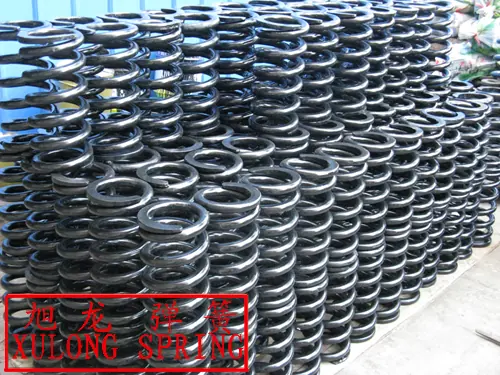
A vibrating screen is one of the most heavily loaded assemblies in a processing plant. Springs here operate close to their limits: continuous dynamic loads, abrasive dust, and temperature swings from +40 °C in summer to −40 °C in winter. Their condition affects not only screening quality but also the service life of bearings, the shaft and the screen box.
We have manufactured large springs for screens and crushers since 1979. Below are the six parameters that define how long a spring will last — and what to look at when replacing one.
1. Rate and working load
The key parameter is not “the size fits” but a match of rate (N/mm) and working load. If a new spring is stiffer than the design value:
- the vibration amplitude of the screen box drops — screening efficiency falls;
- the load on bearings and the drive increases;
- coil fatigue fracture becomes more likely.
If it is softer, the box “sits down”, impacts appear at the stops, and the spring itself quickly loses height. That is why replacing springs “by dimensions alone” almost always ends in premature failure.
A practical rule: for a new spring, request a test report with a force–deflection diagram, not just a drawing. The diagram shows the actual rate and any non-linearity.
2. Wire diameter and coiling technology
For medium- and high-capacity screens, wire from 16 to 40 mm is typically used; heavy-duty screens may need up to 50–60 mm. This is already the range of hot coiling: the wire is heated, coiled, then quenched and tempered.
That is why few factories produce large springs — it takes high-capacity coiling machines, heat-treatment furnaces and testing equipment rated in tens of tons. There are few such producers in South China, and XULONG SPRING is among the best equipped in this field: more than 60 coiling machines, 12 heat-treatment furnaces, compression testing up to 50 tons.
An important detail: in a hot-coiled spring the metal structure must be restored after forming. A spring coiled without subsequent heat treatment loses height within the first weeks of operation.
3. Material: what really affects service life
Screens and crushers use spring steels with a high endurance limit:
| Grade | Feature | When it is chosen |
|---|---|---|
| 60Si2Mn | the classic choice, good fatigue strength | a universal option for heavy duty |
| 55CrSi | resistance to relaxation at elevated temperature | assemblies heated up to +250 °C |
| 51CrV4 | hardenability, stability of properties | critical large springs |
| 65Mn | an economical option | moderate loads, small sections |
| 72A / 82B | high-carbon steel wire | cold coiling, medium loads |
Material is sourced directly from steel mills and comes with a mill certificate — this makes it possible to trace which heat a given batch of springs was made from. Our suppliers are Baowu (Baosteel), Kobe Steel, Bekaert and Qingdao Special Steel.
4. Operating temperature: the key risk for Russia and Kazakhstan
At sub-zero temperatures spring steel tends toward brittle fracture, and grease in the assembly thickens. For machinery operating in winter, two things are critical:
- Impact toughness at low temperature — the material’s ability to resist brittle fracture at −40 °C and below. It is verified by testing specimens in a cold chamber, not “by eye”.
- Rate retention — as temperature drops, the force increases, and this must be accounted for in the assembly calculation.
XULONG SPRING engineers select the steel grade and heat-treatment regime for the climate of operation: for northern regions we recommend grades with higher impact toughness plus shot peening — it raises fatigue life under shock loads. If low-temperature testing is mandatory for your assembly, agree on it in advance: such tests are performed by an independent laboratory, and we will help you prepare the specimens and the technical requirements correctly.
5. Coating: not cosmetics, but service life
Screen springs run in dust with moisture and chemically active media. The working options are:
- zinc plating — the basic, economical option;
- Dacromet — high corrosion resistance without hydrogen embrittlement (important for high-strength steels);
- cataphoresis — an even coating over the entire surface, including the space between coils;
- black oxide + preservative oil — for assemblies operating in an oily environment.
The declared coating can be verified in a salt spray chamber. The factory laboratory has one, and we share the results on request.
6. Geometry and batch inspection
Springs that formally match in size can differ in:
- the number of active and total coils;
- coil pitch and the presence of closed (pitched-to-touch) coils;
- end treatment (ground / unground);
- free height and its tolerance.
For a batch of screen springs it is important that all springs have the same rate within the tolerance — otherwise the load is distributed unevenly and the first spring “drops out”. So when ordering, request:
- a force–deflection test report for the batch;
- geometry inspection (projector, caliper, micrometer);
- the material certificate;
- confirmation of hardness and microstructure.
Checklist for replacing screen springs
- The original drawing, or the parameters of the removed spring: wire, outer diameter, free and working height, force.
- Operating conditions: amplitude, frequency, winter temperature, type of media.
- Coating and corrosion-resistance requirements.
- Documents: test reports, material certificate, product data sheet.
- The batch as a whole, with rate-scatter control.
If there is no drawing, a sketch with the main dimensions and a description of the operating conditions is enough: an engineer at XULONG SPRING will select the design, calculate the rate and confirm manufacturability. Prototypes are produced within 48 hours after the drawing and material are approved; the prototypes are then shipped for testing, and series production starts only after sign-off.
Practice shows: replacing screen springs “by dimensions” without a test report costs more than selecting them correctly at the first order — through line downtime and bearing replacement.
Need a calculation for your screen or crusher? Send a drawing or a series of photos with dimensions — we will prepare an offer with price, lead time and test reports.
Need a calculation for a specific part? Send a drawing or describe the duty conditions of the assembly — a factory engineer will prepare an offer. Contact: sn@snspring.com.