
65G and 60S2A Steel: Chinese Equivalents and Substitution Limits
How the Russian spring steel grades 65G and 60S2A map to Chinese 65Mn and 60Si2Mn(A): a functional cross-reference table, substitution limits and batch testing.
“Use your closest steel instead of 60S2A — it is the same thing anyway.” Requests like this arrive regularly from buyers in Russia and the CIS. The mirror situation happens too: a Chinese supplier’s quotation reads “65Mn (65G)”, and the buyer reasonably asks whether this equivalence can be trusted or whether it exists only on paper. The short answer: the correspondence between Russian and Chinese spring steel grades is real and historically established — but in spring manufacturing, an “equivalent” is proven by the function of the part and by the test results of the specific batch, not by the grade number.
In this article we look at what grades 65G and 60S2A actually are, the parameters against which they are compared with Chinese steels, where substitution is acceptable and where it is not, and how material verification works in practice. XULONG SPRING has manufactured springs to customer drawings since 1979, with a wire and bar range of 0.1 to 80 mm; our quality management system is certified to IATF 16949:2016 (Intertek certificate No. 0495241, which includes ISO 9001:2015 requirements).
Two grades, two different engineering problems
Both grades belong to the base Russian standard for spring steels, GOST 14959 — but they solve different problems.
65G is a high-carbon steel with elevated manganese content. Manganese does one job here: it increases hardenability — the depth to which quenching transforms the cross-section. This lets the steel hold consistent properties after heat treatment in sections where a plain carbon steel would not through-harden. 65G is a workhorse grade for cold-coiled springs of small and medium sections (wire up to a few millimeters) and for coiling from calibrated bar: general-purpose helical springs, stops, retaining and preloading assemblies. In Chinese practice, the closest grade by chemistry and application is 65Mn — one of the most widely produced spring steels in China altogether.
60S2A is a silicon-alloyed steel. Silicon is a strong elastic-alloying element: it raises the elastic limit and relaxation resistance — the ability of a spring to keep its force under long-term static and moderately cyclic loading. Silicon steels are noticeably stronger than manganese grades at the same section size and tolerate higher operating temperatures. The letter “A” in the designation means a high-quality grade with tight sulfur and phosphorus limits. Typical applications: leaf and heavy helical springs, construction and road machinery assemblies, suspension and vibration-isolating springs. The Chinese counterparts are the 60Si2Mn / 60Si2MnA family — the backbone of Chinese spring steel supply.
One technological nuance is often missed when substituting “from a table”: each family of steels carries its own process risks. Silicon steels are prone to surface decarburization during heating — and it is precisely the surface layer that governs the fatigue life of a spring. Manganese grades are sensitive to quench cracks and grain coarsening. In other words, even with a formally correct grade match, batch quality is determined by heat-treatment technology and process control, not by chemistry alone.
What really drives the choice: three parameters instead of one line on the drawing
When a drawing says “steel 65G” or “60S2A”, that line stands for three engineering parameters that any substitution must reproduce:
| Parameter | What it defines | What it means when substituting a grade |
|---|---|---|
| Elastic limit and relaxation resistance | Ability to keep the rated force over the service life | Silicon grades (60S2A / 60Si2MnA) outperform manganese grades here |
| Hardenability | Which section sizes quench to a uniform structure | As the section grows, manganese grades run out of hardenability sooner — core elastic properties drop |
| Operating temperature range | Behavior in heat and in winter cold | Silicon steels hold up better at elevated temperature; in freezing winter conditions, remember the reduced impact toughness of high-carbon grades |
The practical conclusion: substitution is acceptable when these three parameters are reproduced for the specific section and duty — not when the numbers in the designation match. For large sections that we hot-coil (bar up to 80 mm, developed length up to 18 m), hardenability and the quench-and-temper regime are especially critical, so the material of a large spring is always verified by testing — see our quality page.
Chinese counterparts: a cross-reference table by function
Below is the working correspondence we use ourselves when reviewing Russian drawings. It maps by function (chemistry, application, load level) rather than as a formal “translation” of one number into another:
| Engineering task | Russian grade | Chinese grade (GB/T 1222) | Comment |
|---|---|---|---|
| Mass-market springs, small and medium sections, cold coiling | 65G | 65Mn | The closest match by chemistry and application; limits set by section hardenability |
| Static and moderately cyclic springs where relaxation resistance matters | 60S2A | 60Si2Mn(A) | The silicon pair; decarburization control and the tempering regime are critical |
| Highly loaded cyclic assemblies (valve springs, engine components) | 60S2KhA and similar chromium-bearing variants | 55SiCr, 60Si2CrA | Matched by function; confirmed by fatigue testing, not by the grade name |
Why “by function, not by number”: national standards do not form exact pairs. Each grade has its own melt practice, deoxidation ranges and factory property statistics. Writing “65Mn = 65G” is easy; but a spring works not as a letter in a certificate — it works as the stressed state of its cross-section, its surface quality and its structure after heat treatment. That is why we read “material: 65G” on a customer drawing as an indication of the steel class and the level of requirements, and then select the Chinese grade for the specific task. For the broader picture of how Russian drawings are handled in Chinese manufacturing, see our article GOST and DIN: Spring Requirements for the Russian Market.
When substitution is acceptable — and when it is not
Substitution is acceptable when:
- the assembly sees static or moderately cyclic loading, and the required service life is confirmed by calculation and testing, not only by precedent;
- the spring section sits within the hardenability of the chosen grade;
- the heat-treatment process is proven for the specific grade and section: quench and temper parameters, decarburization control, and shot peening of the surface where required;
- the material of the batch is backed by a mill certificate and incoming inspection.
Substitution is inadvisable or requires separate approval when:
- the drawing specifies a class with a high endurance rating (tens of millions of cycles): here the grade is part of the life-assurance system, and any change goes through a test protocol;
- the spring sees impact loading at sub-zero winter temperatures: high-carbon grades lose impact toughness in deep frost, which must be reflected in the steel and temper choice;
- the section of a large spring is close to the hardenability limit — the answer may be a switch to an alloyed grade, not “more of the same 65Mn”;
- the customer is bound by closed corporate standards that fix the material list.
A separate case: the old drawing names a grade that is difficult to source today in the required volume. The right path is not a table swap but a technical proposal: we show which grade reproduces the required property set and prove it by testing the first batch.
How we verify the material of a batch
Grade substitution is not a signature on a quotation — it is a sequence of checks. At XULONG SPRING it looks like this:
- Mill certificate by heat number — chemical composition and grade from the steel producer.
- Incoming inspection — wire/bar diameter, surface, marking; selective chemical analysis where needed.
- Heat treatment to a proven regime for the specific grade and section: quenching, tempering, straightening.
- Hardness and structure control after heat treatment.
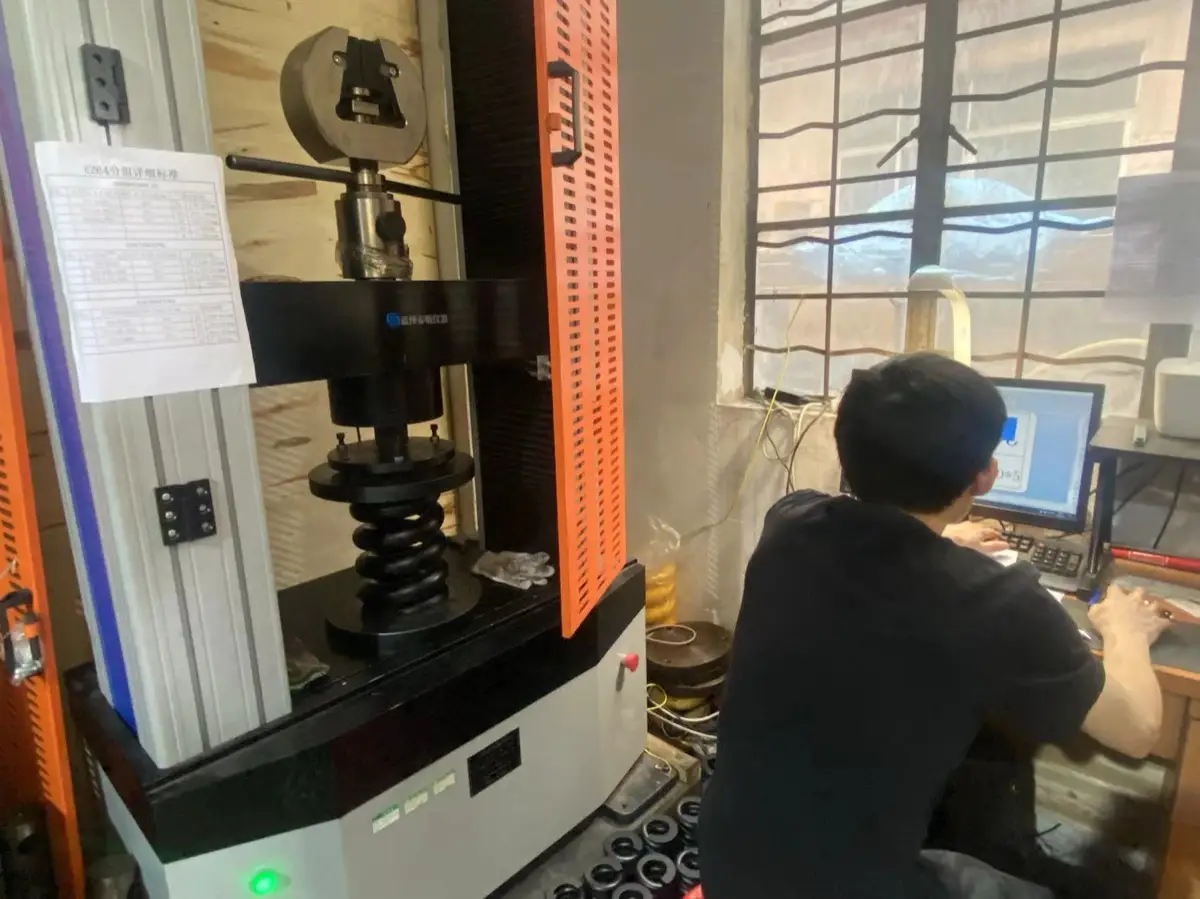
- Load testing — springs are loaded in a range from 50 N to 60 t depending on the class: force at working height and conformity to the drawing’s load characteristic are verified.
- Test report supplied with the batch — on customer request.
The quality management system is certified to IATF 16949:2016 (Intertek No. 0495241, includes ISO 9001:2015 requirements) — the level at which material traceability from heat to shipment is a mandatory procedure, not an option. Production capacity is about 900 tonnes per month, so small prototype batches and serial deliveries run through the same control system.
If the substitution for your assembly needs a documented life proof, we add fatigue testing to the acceptance plan. Questions about the test program can be sent through the contact form — you will get an engineering answer, not generic wording.
What to send us for steel selection
To propose a material and calculate your spring, any one of three data sets is enough (in order of accuracy):
- A drawing with the grade, section, forces and working heights — the ideal case; we read PDFs and scans alike.
- A sample spring — we measure the geometry and load characteristic and reproduce them with a suitable grade.
- A duty description: force and stroke, cycle count, loading pattern (static / cyclic / impact), environment and operating temperature range including winter conditions.
From a drawing we provide a calculation and a quotation; prototypes are manufactured within 48 hours — so before the serial batch you verify the actual load characteristic, not a promise from a cross-reference table. For large sections, see also Large Springs; for general-purpose helical springs, Compression Springs.
How to reach us: message us on Telegram at @xulong_ru_inquiry_bot — attach your drawing directly in the chat — or fill in the form on the contacts page. An engineer will recalculate the task, propose a steel grade for your duty conditions and tell you which tests will be included with the delivery.
Need a calculation for a specific part? Send a drawing or describe the duty conditions of the assembly — a factory engineer will prepare an offer. Contact: info@xulong-pruzhiny.com.