
Hot Coiling Springs up to 80 mm: How the Process Limits Suppliers
How hot coiled spring manufacturing up to 80 mm works: heating, quenching, tempering, shot peening, load testing from 50 N to 60 t — and what to check with a supplier.
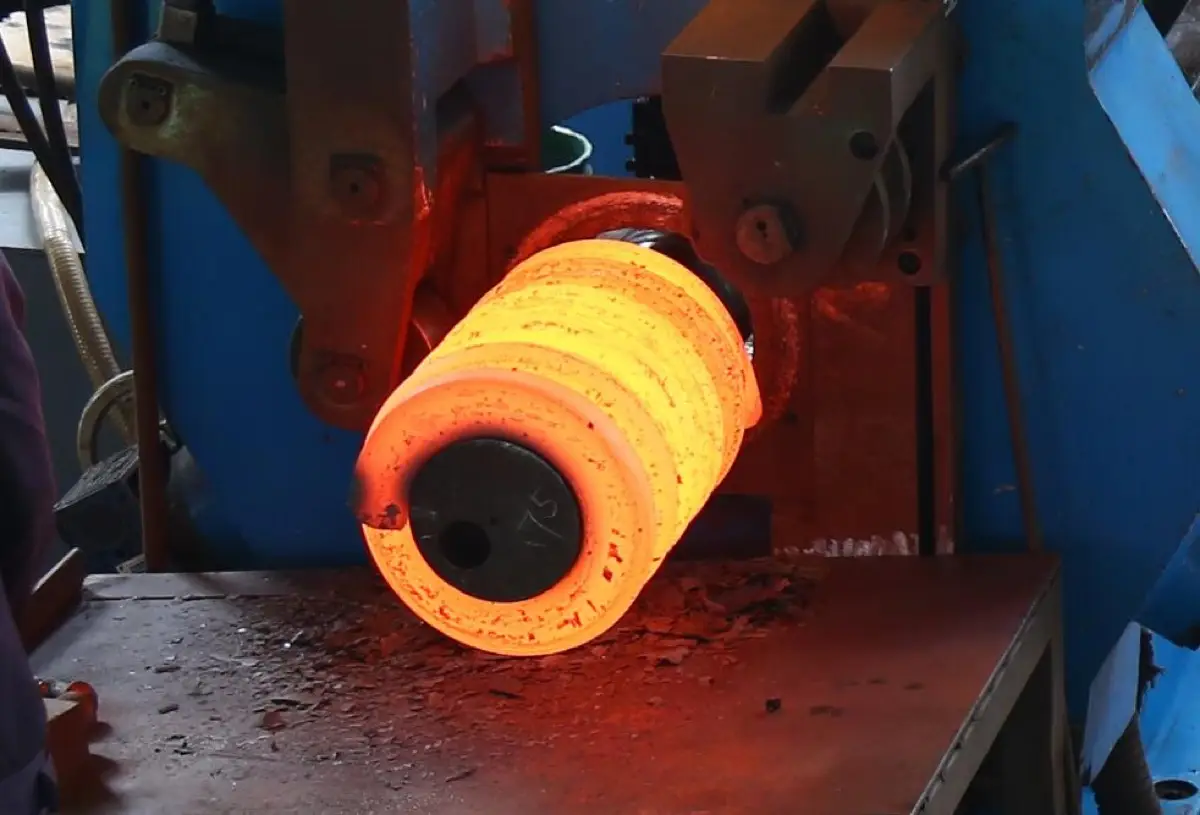
When a spring needs a 40, 60 or 80 mm bar, the pool of capable suppliers narrows fast — and the buyer usually finds out only after sending the drawing. Most offers on the market are written around cold coiling, and the capability boundary surfaces as a polite refusal and a couple of lost weeks. Yet hot coiling is exactly what decides whether you get a functional elastic element for vibration isolation of a large machine, a support spring for a crusher or screen head, suspension for heavy equipment — or no spring at all. In this article we walk through the process the way a manufacturer sees it: where the line between cold and hot coiling sits, which stages make up the production cycle of a large spring, why shot peening matters so much, and how finished parts are tested.
We have been manufacturing springs since 1979 across the full wire and bar diameter range — 0.1 to 80 mm, including hot coiling up to 80 mm with a developed length of up to 18 m; serial capacity is 900 t/month. Our quality system is IATF 16949:2016 (which includes ISO 9001:2015 requirements, Intertek certificate No. 0495241). Below is what we ourselves consider essential in this technology — and what any buyer should check with any supplier of large springs.
1. Where cold coiling ends and hot coiling begins
The technological boundary is drawn by material mechanics, not marketing. Cold coiling works with wire that already received its final strength during cold drawing: the machine simply bends it without heating, and the finished spring gets only a low-temperature stress-relief temper. The process offers excellent repeatability and a clean surface, but there is a physical ceiling — machine force and the ductility of cold-drawn wire. Design references (EN 13906-1) describe cold coiling for bar up to roughly 20 mm, and hot coiling from about 8 mm upward; in real workshops the sensible transition zone for most producers sits somewhere between 14 and 20 mm.
What changes when you switch to the hot process:
| Parameter | Cold coiling | Hot coiling |
|---|---|---|
| Blank diameter | typically 0.1–20 mm | typically from ~14–20 mm up to 80 mm and beyond |
| Material state during coiling | cold-drawn wire, no heating | bar heated to the quenching temperature of the steel grade |
| Where strength comes from | work hardening during drawing | heat treatment: quench + temper |
| Typical equipment | CNC spring coiling machines | heating furnace, coiling machine, quench tank, tempering furnace |
| Typical products | compression / extension / torsion springs of small and medium sections | support and vibration-isolation springs, heavy vehicle suspension, crusher and screen springs |
| Surface | clean as-drawn surface, little finishing needed | scale removed by shot blasting after heat treatment |
A practical takeaway for buyers: if your drawing shows 20 mm of bar or less, cold coiling is almost always faster and cheaper. At 25 mm and above you are already in hot coiling territory — and what needs checking is not the price list but the supplier’s entire process chain.
2. How the process works: heating, coiling, quenching, tempering, straightening
Hot coiling is a single thermomechanical chain in which every stage shapes the properties of the finished spring. Keep this breakdown in mind when you evaluate a production site or read its reports:
| Stage | What happens | What it determines |
|---|---|---|
| 1. Heating | The bar is heated to the quenching temperature set for the steel grade | Uniformity of heating through length and cross-section — it drives geometric stability and quench results |
| 2. Coiling | The plasticized hot bar is coiled onto the machine mandrel | Pitch, outer diameter, number of coils; geometry is expensive and sometimes impossible to correct after quenching |
| 3. Quenching | The coiled blank is rapidly cooled in the quenching medium | Formation of the microstructure on which hardness and elastic properties depend |
| 4. Tempering | Reheating to a set temperature with holding | Relief of quench stresses; final hardness and toughness — the strength-versus-fatigue-life balance |
| 5. Straightening and end finishing | Geometry correction, grinding the end coils flat | Squareness of ends and even load distribution across the coils |
The key feature of this chain is the asymmetric cost of mistakes. In cold coiling almost everything can be fixed afterwards: adjust the pitch, regrind, swap the blank. In hot coiling, a defect made early (underheating, misaligned coiling, a broken quench regime) surfaces only at final inspection — after the material and the furnace hours are already invested. That is why a serious producer keeps inspection not just at the end of the chain but at the input (bar mill certificates), in the middle (temperature regimes) and at the end (testing) — more on our quality control system.
3. Shot peening and stabilization: why a large spring needs both
After tempering, the surface of a hot coiled spring carries two liabilities: mill scale from the heating stage and tensile stress in the surface layer. Shot blasting removes the scale and prepares the surface. But the more important function of the same process for service life is shot peening.
The point of peening is that the stream of shot induces compressive residual stress in the surface layer. A fatigue crack in a spring almost always starts at the surface, where tensile stress peaks; the compressive layer acts as a barrier the crack must first work through before it can grow. For a large spring running millions of cycles in a vibrating machine, shot peening is one of the best value-per-life stages in the whole process, and we treat it as mandatory for critical parts rather than an on-request option.
The second procedure is stabilization: the finished spring is loaded beyond its nominal working force and held. This forces the elastic after-effect — residual set — to complete itself at the factory, instead of showing up at the customer’s site in the first weeks of operation. A stabilized spring keeps its free length and rate under working load; for support and vibration-isolation assemblies that is the difference between “installed and forgotten” and “re-adjusting every quarter”.
One point we always raise with customers: when discussing this with a supplier, specify shot peening with a controlled regime — not simply “shot blasting” as a cleaning step. Visually the results look the same: a clean surface. In terms of fatigue life, they are different things.
4. Testing: geometry, hardness, load from 50 N to 60 t
A finished large spring is verified in three groups of indicators.
Geometry. Free length, outer and inner diameter, pitch, squareness of ends, condition of the end coils. Geometry is checked on every spring — it is cheap and catches coiling and straightening faults immediately.
Hardness after heat treatment. Hardness is the fastest indicator of quench and temper quality: if a regime is broken, the instrument shows it before any fatigue testing. It is checked per batch and recorded in the test protocol.
Load testing. The check that matters most to the buyer: the spring is compressed on a test stand to its working and proof loads, and the force–deflection curve plus any residual deformation are recorded. Our test stands cover 50 N to 60 t — everything from small coiled parts to support springs for heavy equipment. Every batch ships with a test protocol and a product passport; for new items we can supply samples — our standard cycle delivers samples within 48 hours, shipped to the customer for verification before the serial batch starts.
If you are matching your spring’s requirements against GOST and DIN standards (classes, grades, tolerances for your part), we covered that in a separate article on GOST and DIN requirements for springs — including why the two systems cannot be converted into each other one-to-one.
5. Why 80 mm is not “just a bit bigger” but a different class of equipment
From the outside, hot coiling 80 mm looks like coiling 50 mm with a different number in the order. In reality, bar diameter pulls the entire production chain upward:
- The furnace. An 80 mm bar needs deep, uniform heating through its cross-section; a furnace sized for 40–50 mm leaves the core of a thick bar underheated — with all the consequences of quenching “a cold core”.
- Coiling machine power. The force for plastic bending grows roughly with the cube of the diameter: an 80 mm bar needs a fundamentally different machine, mandrel and drive than a 40 mm one.
- In-shop weight and handling. At 80 mm and a developed length of up to 18 m, a single blank weighs hundreds of kilograms; without proper crane tooling and stands, coiling and quenching simply cannot be executed in time.
- Quench and temper tooling — tanks and furnaces sized for that mass and section, with measured temperature control rather than “judging by color”.
- A test stand rated for 60-ton forces — without it, a large spring leaves the factory unverified.
That is why the circle of producers who take 60–80 mm steadily and in series — not as a one-off special order — is small, both in Russia and globally. Our 0.1–80 mm range in one plant means an assembly with both small springs and a large support spring can be sourced from one supplier under one quality system — see large diameter springs on the site.
6. What we ask from the customer for a quotation
To engineer a hot coiled spring and quote a realistic lead time, we need six items. The more complete the input, the more accurate the quotation and the fewer iterations:
| Parameter | What to provide | If you don’t have it |
|---|---|---|
| Drawing | GOST 2.401-68 or DIN format — we accept both | A dimensioned sketch is enough |
| Bar section | Diameter in mm (our hot coiling goes to 80 mm) | We will size it from load and envelope |
| Geometry | Free length, outer diameter, number of coils | Send the assembly dimensions or the old spring |
| Load / rate | Working force and travel (or spring rate, N/mm) | We will work it out from the application together with you |
| Material and environment | Steel grade, or service conditions: load, moisture, dust; winter sub-zero temperatures of the assembly are treated as a service condition when selecting the grade | We will propose a grade based on service conditions |
| Quantity and schedule | Volume, delivery plan | We will calculate economical batch options |
The rest is a standard flow: calculation and quotation, samples within 48 hours for verification on your side, batch test protocols, shipment. If the assembly is unusual (vibration isolation, a heavy-equipment support, non-standard coiling), start with a sketch — we will refine the specification together.
Ready to get your large spring quoted? Send the drawing or assembly parameters via the Telegram bot @xulong_ru_inquiry_bot or through the contact form — we will reply with a calculation, lead time and a sample offer.
Need a calculation for a specific part? Send a drawing or describe the duty conditions of the assembly — a factory engineer will prepare an offer. Contact: info@xulong-pruzhiny.com.