
What Goes Into the Price of a Custom Spring: 5 Cost Blocks
The five cost blocks of a custom spring: material, coiling, heat treatment and shot peening, testing, logistics. Why quotes for one drawing differ by 2–3×.
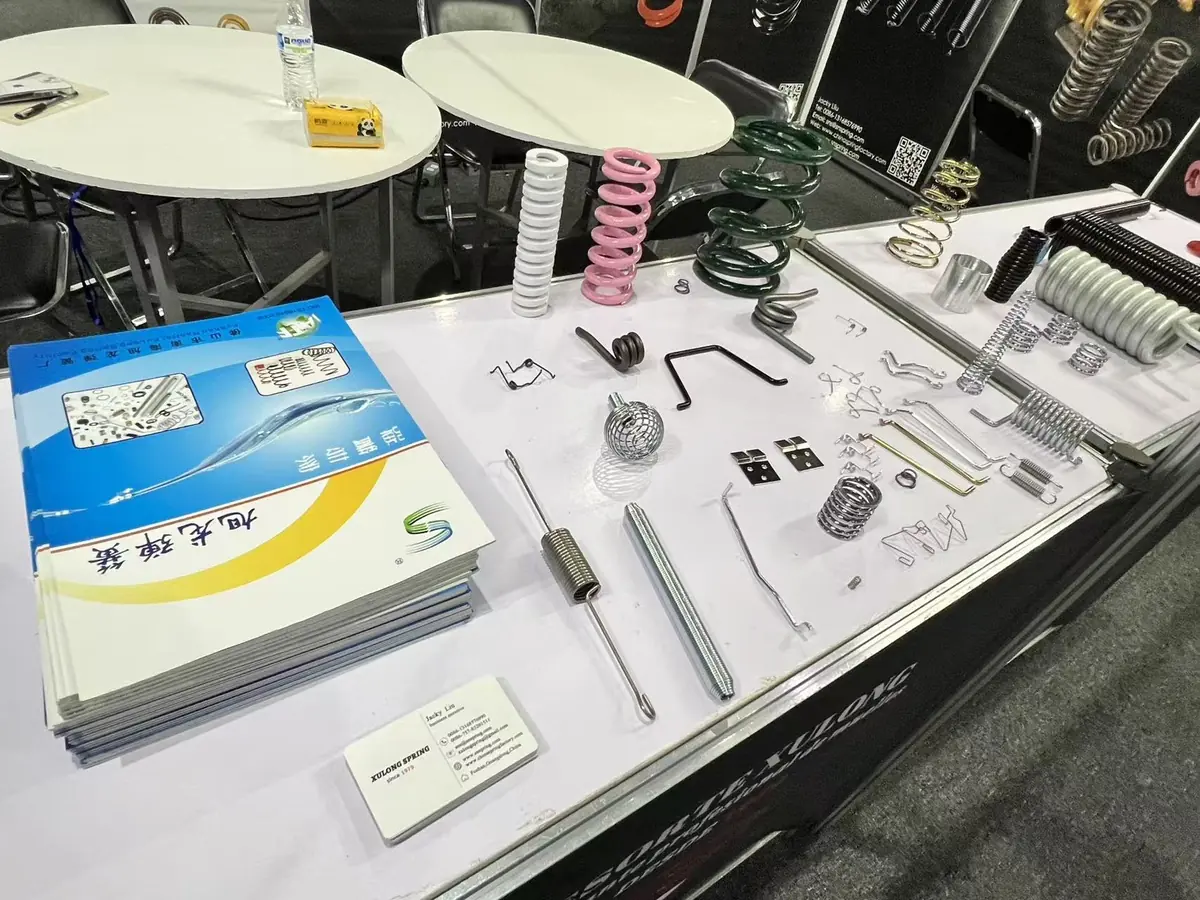
“How much does this spring cost per the drawing?” is a question no honest supplier will answer with a single number. A custom spring is not a price-list item: the price is built up from material, process routing, testing, packaging and logistics — and two factories looking at the same drawing can have fundamentally different routings. That is why this article deliberately avoids quoting any specific figures — only the cost structure and the logic by which that structure changes. For an actual calculation on your drawing, working directly with the factory is faster and more precise anyway.
We have been manufacturing springs since 1979, operate under an IATF 16949:2016 quality system (includes ISO 9001:2015 requirements, Intertek certificate No. 0495241), and ship to more than 40 countries. Below is how the price looks from the factory floor.
1. Five cost blocks: what a spring price consists of
On the factory calculation, the price of a custom spring breaks down into five main blocks:
| Cost block | What it includes | What drives its share of the price |
|---|---|---|
| Material | Spring wire or hot-rolled bar, heat/lot certificates | Wire diameter, steel grade, certificate requirements |
| Coiling and forming | Cold or hot coiling, tooling setup, end finishing | Diameter, coil geometry, geometric tolerance |
| Heat treatment and strengthening | Hardening and tempering, shot peening, stabilization | Load class, required fatigue life, service environment |
| Testing and documents | Load testing, hardness, geometry, protocols, product passport | Customer requirements for inspection scope and documentation |
| Packaging and logistics | Packing, palletizing, delivery to the customer’s warehouse | Batch weight and volume, Incoterms basis, destination city |
A few observations from practice. First, the material share is not a constant: for a small cold-coiled spring with tight geometry, coiling and inspection dominate; for a large hot-coiled spring (ours go up to 80 mm wire diameter, with a developed length of up to 18 m), material and heat treatment make up a significant part of the price. Second, the “testing and documents” block is often underestimated by buyers: a full set — material certificate, load-test protocol (our test bench range spans 50 N to 60 t), product passport — is real work by the QC department and the lab, and it has to be paid for in the price. A supplier who “doesn’t charge for testing” most likely doesn’t do it.
2. Why quotes for the same drawing can differ by 2–3×
The most common situation we see: a buyer sends one drawing to three suppliers and receives prices that differ severalfold. Usually this does not mean someone padded the quote. The typical reasons:
- Different process routings. The same spring can be cold-coiled from finished wire or hot-coiled from bar followed by hardening. For one wire diameter both routes are valid, for another only one — and the difference in labour intensity can be multiples.
- Different tolerances. A drawing with general tolerances and a drawing with tight tolerances on rate and length under load are two different springs in terms of price, even if they look identical geometrically.
- Different inspection scope. “Sample the batch” and “load-test every spring with a protocol” put very different inspection costs into the price.
- Different level of strengthening. A quote without shot peening will always be cheaper than one with it — but the service life under cyclic loading will differ accordingly.
- Different Incoterms basis. An FOB price and a DAP “to your warehouse” price are different bundles of services; comparing the bare numbers without the basis is meaningless.
- Different batch size. A factory offered a batch ten times smaller than its normal series will build production setup into the unit price — see the next section.
The practical conclusion: a cheap quote is not necessarily a mistake, and an expensive one is not necessarily greed. Compare the composition, not the numbers: routing, tolerances, inspection scope, delivery basis. If the supplier’s quotation doesn’t spell out this composition, you have no information to compare — only two numbers.
3. How batch size and tooling affect the unit price
Tooling (coiling arbours, fixtures for complex shapes, gauges) is a one-time cost per product launch. It is spread across the batch in the unit price, and the batch volume changes the picture dramatically:
| Batch size | Share of tooling and setup in unit price | What it means |
|---|---|---|
| Samples and small batches | High | Setup is not amortized — unit price is at its maximum |
| Medium series | Moderate | The classic working range for custom springs |
| Large series | Low | Setup is amortized — unit price is at its minimum |
Three practical rules follow. First: on a first order it makes sense to separate the launch from the series — samples or a small batch for your testing (we produce samples within 48 hours of drawing approval), then a serial batch on a proven routing. The unit price at the sample stage will always be higher than the serial one — that is normal, and an honest supplier will say so upfront. Second: if repeat deliveries are planned, ask whether the tooling is kept at the factory for repeat orders — this directly reduces the cost of a repeat launch. Third: look not only at the unit price but at the “door-to-door” batch cost with logistics — with springs being heavy cargo, shipping can shift the ranking between quotes more than the difference in the spring price itself. We covered this in detail in our articles on shipping springs from China and on payment schemes.
4. The currency and payment factor: why a quotation lives 7–14 days
Spring prices from China are denominated in yuan, and payment is converted at the rate on the payment date — making this the second most significant source (after batch size) of the gap between a quotation and the final invoice. That is why our quotations have a limited validity period — normally 7–14 days. This is not a “decide faster” sales trick; it reflects the fact that the price is tied to the exchange rate and to the production load of a specific period.
What this means for the buyer:
- Plan your decision within the validity window. If internal approval takes a month, ask for a re-confirmation rather than using a stale quotation.
- Fix the settlement currency and the rate condition in the contract (rate on payment date / on shipment date) — this is standard practice, and it is better to spell it out upfront than to discuss it at the first invoice.
- Factor in the payment channel. The transfer method affects both timing and fees — we gave a detailed breakdown of working payment schemes in 2026 in a separate article.
For the same reason, our quotations always state: sample lead time, serial batch lead time, delivery basis, and the scope of the document package. A quotation is not a number but a mini-contract: the more completely it is written, the fewer surprises at shipment.
5. How to write your RFQ so quotes are comparable
The 2–3× spread between quotes is most often cured not by negotiation but by the quality of the initial RFQ. A checklist of what should be in the request so that all suppliers calculate the same thing:
- A drawing with dimensions and tolerances — or, at minimum, a complete specification: spring type, wire diameter, outer/inner diameter, number of coils, free length.
- Load and rate: required force at a specified deflection (or spring rate), with an indication of which parameter must be verified.
- Steel grade or service conditions: if the grade is not specified, describe the environment (temperature, humidity, media contact), load cycling, and the factory will propose a material.
- Heat treatment and strengthening requirements: whether tempering, shot peening, stabilization are required — or leave the decision to the factory.
- Coating: zinc plating, oxide finish, or plain.
- Inspection scope and documents: what to test (sampling / every spring), which protocols and certificates must accompany the batch.
- Batch: one-off or recurring, with an approximate repeat frequency.
- Delivery basis and destination city: FOB, CIF or DAP, warehouse address — without this, comparing prices is meaningless.
A separate recommendation: state in your RFQ which parameters are mandatory and which are “at the supplier’s proposal”. On our capacity — 0.1–80 mm wire diameter, around 900 tonnes of output per month, compression, extension and torsion springs plus wire forms — there are almost always two or three process routes for a single item, and a buyer who lets the factory propose the routing usually gets a better price without losing any characteristics. If you are unsure how to describe your conditions, send the drawing as-is with a couple of sentences about the application: the factory engineer will ask the missing questions. An overview of the product range is in the Products section.
6. How we quote: calculation from a drawing within 24 hours
Our workflow looks like this:
- You send a drawing or specification (format does not matter — PDF, DWG, a photo of a sketch).
- Within 24 hours, an engineer reviews manufacturability and, if needed, asks about load, environment and batch.
- You receive a quotation with the price, sample and serial lead times, inspection scope and delivery basis — valid for 7–14 days.
- After approval, we produce samples within 48 hours, you run your tests, and the serial batch goes into production.
This order means the quotation already includes the routing, inspection and packaging for your specific batch — not an “average temperature across the price list”. The factory operates under IATF 16949:2016 (includes ISO 9001:2015 requirements, Intertek certificate No. 0495241), and every batch ships with a passport and the protocols agreed in the quotation.
A spring’s price reflects the routing, not the outcome of haggling. When both sides see the same routing, the difference between quotes stops being a mystery.
Send us your drawing and get a calculation: a factory engineer will reply within 24 hours. Fast channel — the Telegram bot @xulong_ru_inquiry_bot, or submit your request via the form on the Contacts page.
Need a calculation for a specific part? Send a drawing or describe the duty conditions of the assembly — a factory engineer will prepare an offer. Contact: info@xulong-pruzhiny.com.