
Springs for Mining Equipment from China: Where Demand Actually Sits
Where springs work in mining machinery: crushers, screens, feeders, conveyors, mills. How to order a batch of springs to drawing with load testing from 50 N to 60 t.
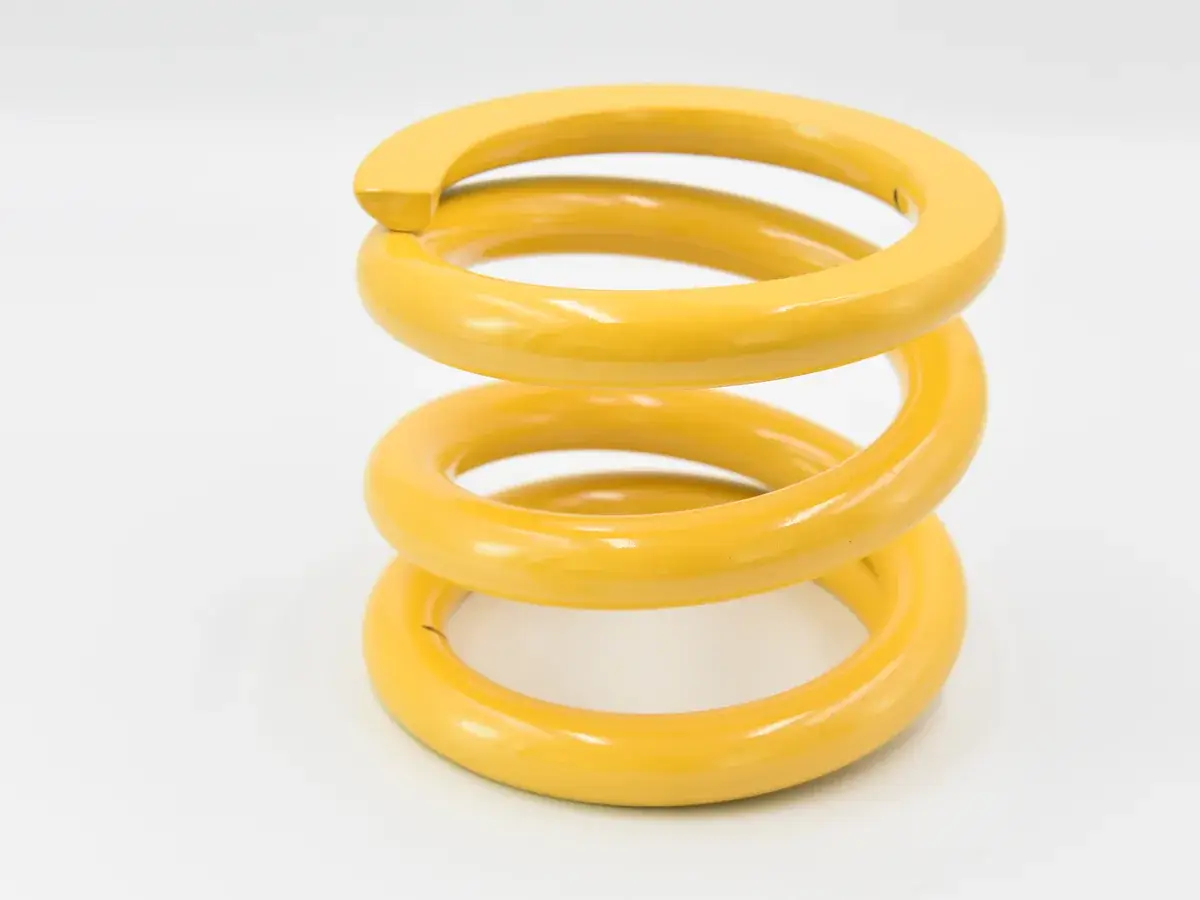
Ask a procurement officer at a processing plant when they last thought about springs, and the honest answer will be: when an assembly went down. A spring in mining machinery is not a “fit-and-forget” component — it is a wear part with a finite service life, working under shock and cyclic loads, in abrasive dust, under constant vibration and through seasonal temperature swings: on open sites, assemblies face hard frosts in winter and heat and the same dust in summer. That is why in mining procurement springs are almost always a separate purchase line: with a drawing, a batch, a test and documents.
In this article we map the spring assemblies by type of mining equipment, explain why spring demand is durable precisely as spare-part demand, and walk through the practical mechanics of ordering a batch: which data to prepare, what to require from a supplier, and what the path from drawing to shipment looks like.
The assembly map: where springs actually sit in mining equipment
A useful first step when planning a purchase is to go through machine types and identify where springs live in each of them. This kind of “demand map” works equally well for managing your own fleet and for talking to a supplier: the conversation immediately shifts to the level of assemblies instead of abstract “springs for machinery”.
| Equipment type | Spring assembly | Spring type | Load character |
|---|---|---|---|
| Crushers (jaw, cone) | tension and damping springs of the adjustment and overload-protection mechanism | large compression springs, heavy bar | static preload + shock peaks when unbreakable material passes |
| Vibrating screens | support springs of the screen box | cylindrical compression springs | high-frequency cyclic loads, vibration |
| Vibrating feeders and conveyors | support springs of the working body | compression springs and composite vibratory units | resonant regime, millions of cycles |
| Belt conveyors | tension and cushioning units, idler frames | compression and extension springs, small and medium diameters | steady medium loads |
| Mills and vibration foundations | isolation springs under equipment and foundations | large compression springs | statics + low-frequency vibration |
| Couplings and fixture assemblies | return springs, latches | torsion springs, wire forms | light cyclic loads |
The table makes one point immediately clear: “a spring for mining equipment” is not one part but several entirely different families. For a screen, what matters is the endurance of the coil over millions of cycles; for a crusher — the exact preload force and margin against shock peaks; for a mill’s vibration foundation — a stable rate under multi-ton statics. A supplier who can do both cold coiling of fine wire and hot forming of bar up to 80 mm covers the whole map — without sourcing a separate mill for every category. We covered the selection of springs for the most cyclically loaded assembly on this list, the vibrating screen, in a dedicated article; here we look at the picture as a whole.
Why spring demand is “repair-driven” — and why that will last
The second layer of the map is economic. A large share of the Russian mining fleet consists of machines well into their service life, and the industry’s renewal logic in recent years has not been building new lines but replacing key components: processing plants modernise their crushing and classification sections by swapping worn equipment within existing operations. For springs this means exactly what it means for the rest of the spare-parts list: demand is set not by new plants starting up but by the wear of the ones already running.
At the same time, springs are ordered not only for old machines but also by new projects that are genuinely moving in 2026. In gold mining, commissioning continues at the Veduga processing plant in the Krasnoyarsk region, with production expected in the second half of the year; the Chernogorsky mining and processing plant (copper, nickel and platinum-group metals) near Norilsk is due to enter industrial operation in the fourth quarter. Every new section — crushing, screening, transport — means both a new fleet of spring assemblies and a future flow of orders for their maintenance. The picture is structurally uneven, though: alongside gold, copper and nickel projects, part of the coal pipeline is on hold, and that is not a temporary pause but a shift that will hold for years. The correct conclusion for procurement is therefore: durable demand sits in the repair and maintenance of the operating fleet, plus a wave from projects entering service — not in any across-the-board expansion.
It is telling where the industry discusses this agenda: from 27 to 29 October 2026, Yekaterinburg hosts the “Rudnik / MINE.URAL” exhibition, which includes a dedicated section for “Spare parts, components and consumables”. The fact that spare parts get their own section at the industry’s flagship venue is not a marketing gesture — it reflects the real structure of mining procurement.
What to prepare for the supplier: three sources of data for the specification
A spring ordered as a spare part differs from a “project” spring in one practical respect: the input data rarely arrives as a ready drawing. The machine may have changed hands, the documentation may sit with a service organisation, and the assembly may have been reworked by hand over years of operation. Before requesting a quote, the data can be assembled from three sources — in descending order of precision:
- A drawing or part catalogue. The ideal case: part number, material, tolerance on force. If you have it — send it as is; that is enough for calculation and a quotation.
- A dismantled sample. The most common situation. The spring can be measured and shipped to the supplier: outside and inside diameter, free length, number of coils, wire diameter, pitch. From a sample the factory reconstructs the geometry and selects material and heat treatment; if you have a test rig, measuring the force on your side is a major advantage.
- Measurements on the running machine. If there is no sample either, take the operating parameters of the assembly: the seat dimensions, the travel, an estimated force, the machine’s duty cycle. This is the longest route, with iterations — but it works, and the supplier’s engineer will help you draw up the measurement list.
Along with the data, attach the service conditions that affect the design: outdoor operation (which raises the coating and corrosion question), dust load, the nature of the load — static, cyclic or shock — and seasonality, including regional winter frosts. What you state is the environment itself; the requirement for resistance to it is formulated in the specification and confirmed by testing to an agreed method. In large orders, practice is consistent: the fuller the initial data package, the fewer iterations to the series and the better the match to the assembly’s service life. On how to hold stock of such items and avoid stopping equipment while waiting for a batch, see our article on spare-part stock planning.
The production side: what a factory must deliver for a mining order
Not every spring plant can cover the assembly map in the first section. Let’s go through what a mining order actually demands and how our factory provides it.
Bar range — from fine wire to hot coiling. Small and medium springs (return, tension, idler frames) are cold-coiled from wire down to 0.1 mm; the support springs of screens, crushers and vibration foundations use bar that, at large diameters, can only be formed hot. We manufacture springs across the full range from 0.1 to 80 mm: hot coiling up to 80 mm with a developed length of up to 18 metres — precisely the segment of the map where most suppliers drop out.
Capacity for a series batch. Replacing assemblies one at a time is an expensive regime for production and for logistics; a real purchase is a batch. Our serial capacity is 900 t/month, and our material warehouse is fed directly by steel mills: for large springs the grade and heat-treatment regime of the bar are critical, so batch traceability is a baseline requirement, not a bonus.
Control matched to the load character. A spring for mining equipment is verified by force: our testing machines cover 50 N to 60 tonnes, six stands in total, so acceptance of a large batch never becomes “sampling by queue”. For cyclically loaded assemblies, service life is carried by the combination of “material + heat treatment + shot peening”: cold-working the coil surface measurably raises fatigue endurance, and every treated batch has a regime record. The plant’s quality system is IATF 16949:2016 (which includes ISO 9001:2015 requirements, Intertek certificate No. 0495241) — the same process discipline the automotive industry demands.
Design matched to site conditions. The coating — zinc plating, cataphoresis, Dacromet, oxide — is selected for the service environment and fixed in the specification; the factory’s salt spray chamber lets us verify coating resistance to an agreed programme. We do not quote “universal” service lives: conditions at a screen in a quarry and at a vibration foundation indoors are different, and it is more honest to express this in a test method than in a round advertising number.
What the purchase looks like: from enquiry to batch shipment
For a procurement officer ordering springs as spare parts from China, the sequence fits into a few steps:
- Enquiry with a data package — drawing, measurements or a sample, plus service conditions; most conveniently via the form on the contacts page or the Telegram bot linked below.
- Calculation and quotation — an engineer confirms manufacturability and proposes material and design; the quotation is discussed in terms of the assembly, not a “price per piece without a drawing”.
- Samples in 48 hours — once the drawing is agreed, sample manufacturing takes 48 hours; you verify them in your assembly or on your rig, and only then confirm the series.
- Serial batch with documents — test report, product passport, material certificate; packaging marked with Russian-language data so that receiving at your warehouse does not turn into decoding.
- Planning the next order — the safety stock is built from the actual consumption of assemblies; the calculation method is in our stock planning article, and the full batch control cycle is in our factory acceptance overview.
We have been manufacturing springs since 1979 and supply equipment manufacturers and service companies, including the mining sector: the assembly map above is not a theoretical scheme but a cross-section of what actually leaves our shop floor. If you are equipping a fleet with spare parts or choosing a supplier for a series, the industry section Springs for the mining industry gives a quick summary of sector requirements, and large hot-coiled springs covers the narrowest segment of the map in detail.
How to start: send a drawing, measurements or a photo of the dismantled spring to the Telegram bot @xulong_ru_inquiry_bot — files can be attached right in the chat — or fill in the form on the contacts page. An engineer will tell you what can be determined from your data, what needs measuring, and how to prepare the specification for a batch.
Need a calculation for a specific part? Send a drawing or describe the duty conditions of the assembly — a factory engineer will prepare an offer. Contact: info@xulong-pruzhiny.com.