
Springs as Spare Parts: How to Size Safety Stock and Cut Downtime
How to size spare spring stock: residual life by cycles, the formula (consumption × lead time + safety stock), downtime versus frozen capital, stock batch marking.
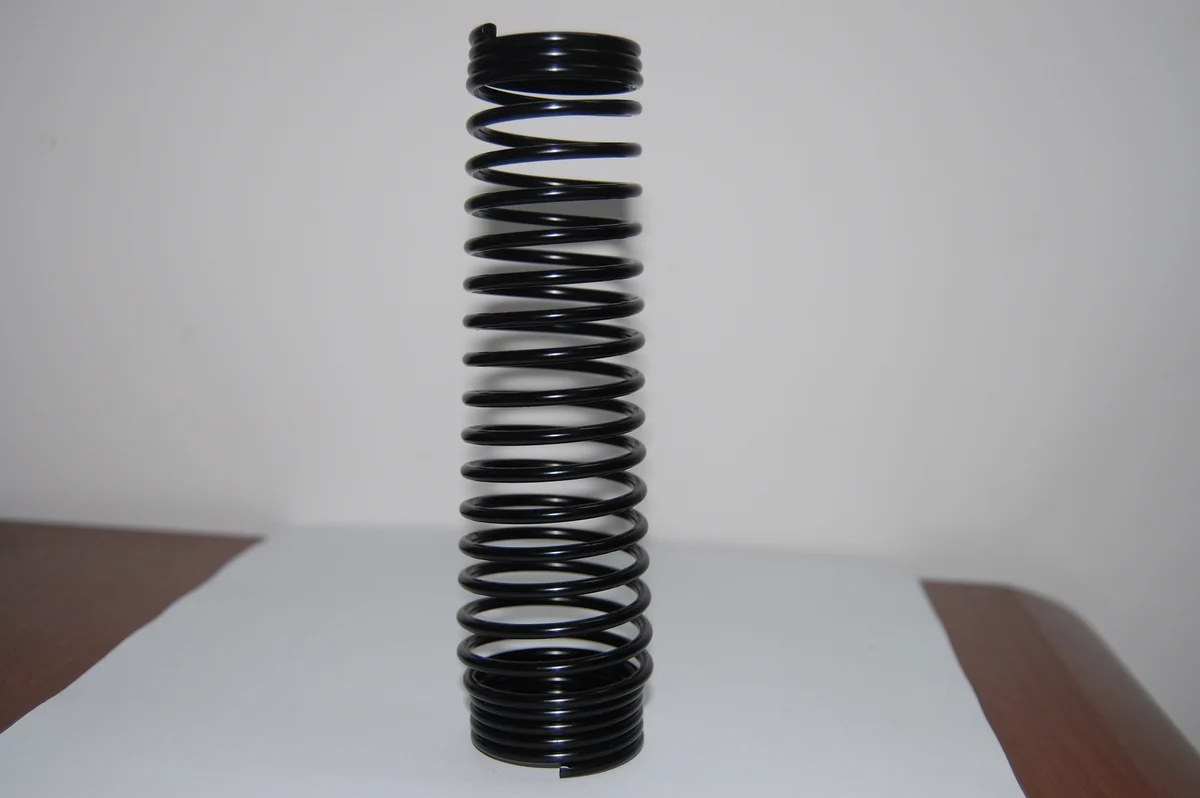
Every maintenance manager knows this situation: a screen or a press stops, and it turns out no spring set was ever kept in stock — “that part lasts for years.” Two days of downtime later, there is an urgent airfreight order and negotiations run in emergency mode. Yet a spring is closer to a consumable than to a “lasts-the-life-of-the-machine” component: it works under cyclic loading, accumulates fatigue and ages together with the equipment. In this article we treat the spring exactly as a stock-keeping item: how to estimate its service life, how to size stock with the formula “consumption × lead time + safety stock”, and what a factory-supplied stock batch looks like.
One note on structure: in a separate article we already covered how to select a spring for a screening machine — that one was about matching a spring to service conditions. Here we mostly stay away from selection: the assumption is that the spring is already selected and running, and the task is to make sure it never finds the storeroom empty.
We have been manufacturing springs since 1979, operate under an IATF 16949:2016 quality system (includes ISO 9001:2015 requirements, Intertek certificate No. 0495241), and ship serial and spare batches to more than 40 countries, including the mining sector — see the overview of that segment on our site.
1. Why a spring is a consumable, not a “ten-year part”
A spring has no “warranty mileage” because its working life is defined not by the calendar but by the number of load cycles. A machine running two shifts “consumes” its springs twice as fast as an identical machine on one shift, even though on paper both have been “operating for the same time.” The main factors that eat into spring life:
- Cyclic fatigue. Every operating cycle is microscopic material movement in the zone of maximum stress. For vibrating machines (screens, feeders, vibrating tables) the cycle count runs into the millions over months of operation.
- Overloads and shocks. Starting under load, jamming, oversized material getting through — each such event can leave a mark in the material that shows up thousands of cycles later.
- Corrosion. Moisture, dust and aggressive media reduce the effective cross-section of the wire; a smaller section means higher stress, and higher stress means shorter life.
- Ambient temperature. Winter sub-zero conditions and summer heating both change the operating conditions of the assembly; the climate outside is a service condition to be accounted for at selection — not something to forget about until the first hard winter.
- Worn or misaligned seats. A worn saddle or a shifted support acts like an abrasive on the coils.
The practical conclusion: every spring position in the plant has an actual, measurable service interval, and it differs from machine to machine. The maintenance department’s job is to measure it, not to guess.
2. How to estimate residual life by cycles and service conditions
A rigorous residual-life calculation requires load data and material properties that the shop floor usually doesn’t have. But for stock planning none of that is necessary — three sources of information are enough:
- The replacement log. The most underestimated document there is. If you record the installation date and the replacement date of every spring (at least by assembly), after a year or eighteen months you will have the actual replacement interval for each position — the best possible basis for stock calculations.
- Indirect signs of ageing. Set (the spring sits below its free length), loss of rate (under the same load the deflection is larger than it used to be), coil contact marks, cracks near the end coils, corrosion spots. Regular inspection during planned shutdowns turns a “sudden fracture” into a “planned condition-based replacement.”
- Service conditions. The same machine on a dry screening plant and in a constantly humid workshop wears its springs differently. If conditions have changed — a new medium, a different material, higher throughput — the replacement interval has to be re-estimated; old statistics no longer describe reality.
A practical rule: when no statistics exist yet, treat the interval recommended by the equipment manufacturer as the upper bound and plan the first stock purchase against it; the replacement log will quickly correct that figure down or up. What you should not do is promise yourself that “this spring will last N years” — for spring positions that is the weakest assumption of all.
3. The stock formula: consumption × lead time + safety stock
Once consumption and lead time are known, the stock level follows a simple logistics formula:
Reorder point = consumption per period × lead time + safety stock
Breaking down the terms:
| Parameter | Where the value comes from | Comments |
|---|---|---|
| Consumption per period | Replacement log: how many pieces of the position are used per month/quarter | Track per position, not “springs in general”: a screen and a press differ by an order of magnitude |
| Lead time | Batch production at the factory + delivery to your warehouse | For an imported serial batch this is weeks; for transit times from China we published a separate breakdown |
| Safety stock | A share of the consumption over the lead time | The costlier the downtime and the less you trust the statistics, the higher the share |
An illustrative example (the figures are hypothetical, for the sake of the method). Say the replacement log for a “screen spring” position shows a consumption of 4 pcs per quarter, the lead time for a serial batch is about 8 weeks, and screen downtime is critical, so the safety factor is 50% of consumption over the lead time. Consumption over the lead time is 2 pcs, safety stock 1 pc, reorder point 3 pcs. Then procurement discipline takes over: as soon as stock falls to 3 pcs, the next batch is ordered. Rounding should follow the set size of the machine: if a screen carries 8 springs, it is more practical to keep stock in multiples of the set (or half-set), so a component overhaul never strips the batch piece by piece.
Three practical refinements. First: safety stock is not a “just in case” buffer — it is the price of two kinds of uncertainty, variability of actual consumption and variability of lead time; the more stable both are, the less you need to hold. Second: for positions where downtime is critical (the main production line) the safety share is higher; for auxiliary equipment it is lower. Third: recalculate the formula whenever conditions change — new material, different shift intensity, a new supplier with a different lead time.
4. Which is more expensive: holding stock or waiting for a batch
The stock formula has an economic side that is rarely discussed honestly. Compare three strategies:
| Strategy | Pros | Cons | Where it fits |
|---|---|---|---|
| No stock, buy per replacement | No capital tied up | Downtime for the full lead time; for a critical position the losses usually dwarf the saving on warehousing | Positions with long replacement intervals and easy replacement |
| Maximum stock “for years” | Full independence from lead times | Frozen working capital, warehouse space, write-off risk if the assembly is modernized | Rarely justified; almost always excessive |
| Calculated stock per the formula | Balance: batches arrive at the reorder point while capital keeps working | Requires inventory discipline and recalculation | The default option for serial equipment |
Keep in mind the key asymmetry: the cost of storing springs is mostly frozen money and a few square metres of shelving. The cost of unplanned downtime of a screen, conveyor or press is a stopped production programme. A spring is compact and light relative to the value it carries in its assembly, so a spring stock almost always pays for itself more easily than a stock of large castings or gearboxes. Hence the maintenance manager’s rule: “expensive to hold” is almost never an argument against a spring stock; the only valid argument is an honestly calculated low consumption.
5. What a “stock batch” looks like from us: series, marking, packaging by position
Stock supply differs from a one-off delivery in one word: repeatability. When the second batch arrives six months later, it must be identical to the first in fact, not in the name of the position. Here is what we do about it:
- Serial batches on a proven routing. The first batch goes through approval and testing; the tooling stays at the factory, and repeat orders run on the same routing — the same material, the same coiling, the same heat treatment and shot peening where specified. For the large mining-sector positions (hot coiling up to 80 mm wire diameter, developed length up to 18 m), routing repeatability is the key requirement, and our large-spring production is built precisely for serial repeats.
- Marking on every spring. The batch ships with position marking and a product passport; on request — cross-referenced to your internal part numbers, so the storekeeper never has to guess which spring belongs to which assembly.
- Load testing. Our test bench covers 50 N to 60 t; the load characteristic of the batch is verified to the agreed inspection scope, and the protocol travels with the batch — stock lying in the warehouse must be documentarily identical to what was accepted.
- Packaging by position. For a stock batch, packaging is divided by position and by set — so similar-looking springs of different positions are never mixed at receiving or at issue from the storeroom.
- New positions start with samples. If a position has no delivery history yet, we produce samples within 48 hours of drawing approval; you test them in your own assembly, and only then does the batch go to stock — so your stock starts with a verified part, not with a hope.
6. What to send us to build your stock specification
To build a stock-batch specification across your nomenclature and price it, send us:
- The list of positions: a drawing, a photo with dimensions, or an old sample — for each one. If there is no drawing, we can measure from the sample.
- Service conditions per position: the assembly (screen, press, suspension), cycling, medium and operating temperature range — needed to confirm the material, not for marketing.
- Actual consumption or replacement interval — from the replacement log; if no statistics exist, say so and we will propose a first purchase sized for recalculation.
- Desired delivery frequency — quarterly, twice a year; it drives the batch size and the logistics.
- Marking and packaging requirements — internal part numbers, division by assembly, packaging requirements.
Against that list we will return a quotation with per-position prices, production and delivery lead times, the inspection scope and the document package. The factory operates under an IATF 16949:2016 quality system (includes ISO 9001:2015 requirements, Intertek certificate No. 0495241), produces around 900 tonnes of output per month, and ships serial spare batches to more than 40 countries.
A spring stock is not a budget expense but insurance for the production programme: a part the size of your hand protects a shift that costs many times more.
Send us your list of positions and get a stock-batch specification: a factory engineer will reply within 24 hours. Fast channel — the Telegram bot @xulong_ru_inquiry_bot, or submit your request via the form on the Contacts page.
Need a calculation for a specific part? Send a drawing or describe the duty conditions of the assembly — a factory engineer will prepare an offer. Contact: info@xulong-pruzhiny.com.