
Spring Drawing: What a Factory Needs to Quote Price and Lead Time
Which parameters a spring drawing must contain for a factory to quote price and lead time: the minimum set, six common gaps, GOST vs GB, alternatives.
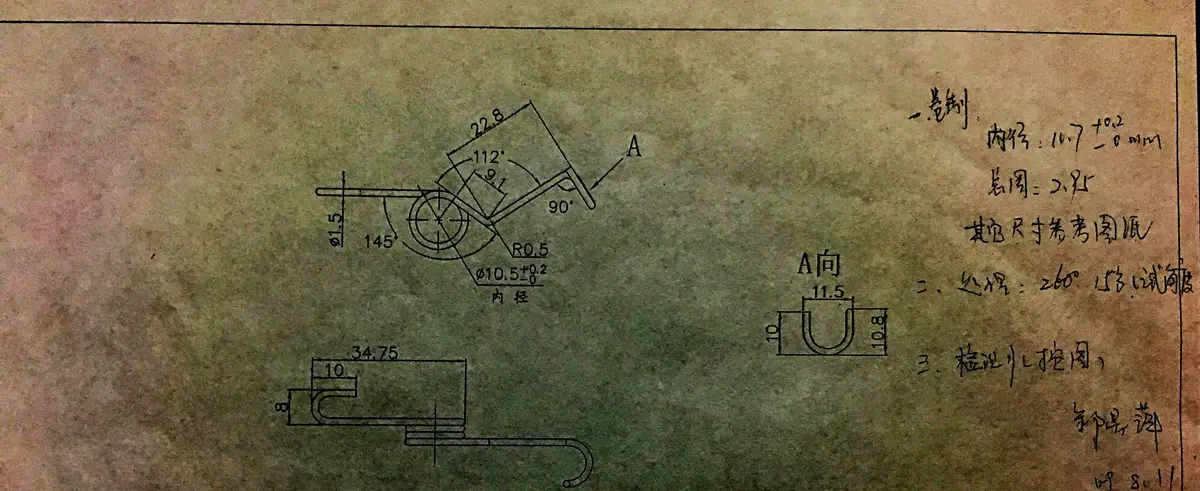
The question “how much does a spring cost to drawing” almost always arrives before the drawing. A buyer wants the order of magnitude before spending an engineer’s time on paperwork, which is reasonable. But price and lead time in spring manufacturing are not properties of a material or a category — they are the output of a specific geometry, material and inspection requirement. Two springs that look identical, both “compression, 20 × 100”, can differ threefold in price because of the rate tolerance, the end type, or whether shot peening is required.
So what follows is not a drafting tutorial. It explains what a factory actually calculates from your data, with one goal: that the reply to your drawing is a quotation you can compare, not a list of questions that stretches correspondence over two weeks.
Why a price cannot exist without a drawing
A quotation for a spring is a sum across eight positions, and every one of them is defined by the drawing. When that data is missing, a factory either asks questions or — worse — quotes on assumptions and prices the risk in. The second option is always more expensive for the buyer.
| What the factory needs to know | What it determines |
|---|---|
| Wire diameter d | Billet mass and material cost, which coiler is used, whether hot coiling is needed |
| Diameters D, D1, D2 and free length L0 | Wire consumption and developed length, tooling envelope, packing volume |
| Number of active coils, pitch, end type | Machine time on the coiler, whether end closing and grinding are required |
| Material grade | Wire price, heat treatment cycle, whether quench and temper are needed |
| Loads at specified heights (or spring rate) | Geometry calculation and the load-test programme that proves it |
| Tolerances | Accuracy class, inspection scope, acceptable rate of adjustment |
| Surface treatment | Coating or shot peening: cost, lead time, a separate operation |
| Planned batch size | Tooling, setup, launch mode — from a single piece to a series |
Note the last row. Batch size is a costing input even though it never appears on the drawing, which is why a competent supplier always asks for the volume behind a “please quote this drawing” request: the setup either amortizes over one piece or over a thousand. We covered that economics in the article on what goes into the price of a custom spring.
The mandatory minimum on a spring drawing
The set below is what allows a calculation to start with no follow-up questions. It is not a box-ticking formality: each item closes a specific uncertainty in production.
| Parameter | How it is specified | Why the factory needs it | If it is missing |
|---|---|---|---|
| Wire diameter d | Ø with tolerance | Determines machine, tooling and material | Calculation is impossible |
| Spring diameters | D (outside), D1 (mean), D2 (inside) — at least two of the three | Consistency check of the geometry and fit in the assembly | The engineer reconstructs the third value; risk of a fit error |
| Free length L0 | mm, with tolerance | Developed length, envelope, packing | Material consumption and cost cannot be established |
| Number of coils | Active n and total | Coiling time, spring rate | Rate calculation becomes an assumption |
| Direction of coiling | Right or left hand | Kinematics of the assembly, operation in pairs | The spring may not fit the mechanism or may work incorrectly |
| End type | Closed, closed and ground, open, open and ground | Closing and grinding operations, stability under compression | A default is chosen — often the wrong one |
| Load at a specified height | P1 at H1, P2 at H2 (or spring rate) | The primary acceptance criterion and the test programme | Rate is inferred indirectly and acceptance becomes a debate |
| Material | Grade to GOST/GB, or a statement of operating conditions | Cost, heat treatment cycle, corrosion resistance | The plant proposes its stock material, which may not be acceptable |
| Surface treatment | Coating type and/or shot peening | A separate operation that affects cost and lead time | Coating is left out of the price and surfaces later |
A practical note on diameters: all three (D, D1, D2) are unnecessary, but two are required. If only the outside diameter is given, the rest are reconstructed through the wire diameter, and any inconsistency becomes a question at the approval stage.
On loads: “spring rate approximately 15 N/mm” does not work. Rate is a derived value, whereas acceptance on the test stand is by load at a stated height. The drawing needs the height–load pair, not a single number.
Six gaps that come up again and again
Reviewing incoming drawings, the same six omissions repeat with remarkable consistency. Each costs one or two rounds of correspondence — or, more expensively, a batch that has to be remade.
1. Working height without a load, or a load without a height. The drawing states “P = 300 N” but not at which height, or states height H1 but not the load required there. Without the pair, acceptance testing turns into negotiation.
2. No tolerance on spring rate. Scatter in rate always exists and is always standardized. If the drawing says “rate 12 N/mm” with no tolerance, the accuracy class gets proposed by the factory — and it may not match what the assembly needs.
3. Direction of coiling omitted. For a single spring this is often irrelevant, but in a pair (dual-spring suspension, mechanism with a screw pair) left- and right-hand are not interchangeable. If direction is not specified, the plant makes right-hand — the most common execution.
4. End type described in words. “Ends machined” is not a parameter. Be specific: closed and ground, closed unground, open. This affects rate (closed coils do not work), cost (grinding is a separate operation) and stability under compression.
5. Heat treatment and hardness not stated. For a spring-steel part, the treatment cycle effectively defines elastic behaviour. With neither a hardness requirement nor a note on quench and temper, the plant applies the standard cycle for that grade — usually correct, but worth knowing what you get by default.
6. Coating named rather than specified. “Zinc plated” without a thickness, and without saying whether it covers the entire surface, leads to a dispute at acceptance. For aggressive environments, add the surface preparation requirement.
There is a seventh, non-technical gap: units and projection. An inch drawing without an inch note is the classic factor-of-25 error, and first-angle versus third-angle projection produces mirrored views. One line in the title block settles both — but check it before sending.
Different drafting traditions: GOST versus GB in practice
“Working to GOST” and “working to GB” do not make drawings incompatible. These are different documenting conventions, and knowing them saves rounds of clarification.
| What we compare | GOST practice | GB practice (Chinese) |
|---|---|---|
| Accuracy | Accuracy class and grade per the spring standard | Accuracy class per the national spring standard, often with a group |
| Dimensioning | Dimensions on views, parameters in a table or in the technical requirements | More often a flat callout of all dimensions on one view plus a list of technical requirements |
| Material | Grade to GOST (e.g. 65Г, 60С2А) | Grade to GB (65Mn, 60Si2MnA) — close in properties, not identical in designation |
| Unspecified tolerances | Reference to a standard in the technical requirements | Reference to the national standard, often with a class |
| Projection | First angle (European practice) | First angle, though export drawings sometimes use third angle |
| Language of notes | Standard wording | Chinese characters plus English notes on export versions |
The practical conclusion is simple: do not redraw your drawing to match someone else’s tradition. Send your original, with material designated in your own system and the accuracy class stated. A plant that works with Russian customers reads both layouts; difficulties arise not from the format but from missing data. If the material is specified to GOST and no stock equivalent is available, the engineer will propose a substitution with justification — covered in the article on steels 65Г and 60С2А and their Chinese equivalents.
One distinction is often blurred: a standard (GOST, DIN, EN) answers which accuracy classes exist and how parameters are normalized; a drawing answers which spring is needed in this assembly. The first is a reference framework — broken down in the article on GOST and DIN requirements for springs — the second is a production order.
When there is no drawing: three workable alternatives
The absence of a drawing is not a dead end. Three routes are used in practice, each with a different accuracy.
| Route | What you provide | Accuracy of the result | When it fits |
|---|---|---|---|
| Sample | The removed spring, ideally with its geometry preserved | High: the plant measures it and reconstructs the drawing for your approval | A broken or worn spring exists and the assembly is accessible |
| On-site measurement | Seat diameter (bore or mandrel), free and working height, travel, photos of the assembly, envelope limits | Medium: geometry is recoverable, load is calculated | The spring is lost or destroyed but the assembly is open |
| Reverse calculation from load | Working load, working travel, envelope limits, environment and operating temperature | Calculated: the plant designs the spring for your duty | A new design, where the spring does not yet exist |
The first route is the most accurate, with one catch: a spring that has run in service has already lost part of its free length (set), so it must be measured with a correction — and you should say up front that it was in service. The second works when seat dimensions are known: even bore diameter and pocket depth impose serious constraints. The third is the only option for a new design and demands the most discipline on inputs, because the calculation starts from load and travel and everything else is derived.
The rule for all three: the reconstructed drawing comes back to you for approval before launch. That is not a formality — it is where mismatches between “how it was” and “how it should be” get caught.
What happens to the drawing next: 24 hours, samples, first batch
Once the data arrives, a standard chain starts. Step one is a manufacturability review: can the geometry be produced on the available equipment, and are there design problems — pitch too large relative to wire diameter, insufficient stability under compression in long small-diameter springs, incompatible end requirements. Drawings often need correcting here, which is better learned before the quote than after the first batch.
Step two is the quotation. At our plant it takes up to 24 hours provided the data is complete; a request without loads or without an end type comes back with questions, which is a normal exchange rather than an excuse.
Step three is samples in 48 hours from drawing approval — from approval, not from the first email, because production starts against a confirmed document. How those two days are built is covered in the article on spring samples in 48 hours.
Step four is approval of the first batch. The drawing stops being correspondence and becomes an acceptance document: the load test report is issued against it, which is why acceptance criteria belong in the drawing rather than in a discussion afterwards.
Our plant has produced springs since 1979, with wire diameters from 0.1 to 80 mm — from cold coiling of fine wire to hot coiling of bar stock with a developed length of up to 18 metres; series capacity is 900 tonnes per month. Load testing runs on stands from 50 N to 60 t, so both precision-mechanics springs and large components for mining equipment are accepted to drawing. The quality system is IATF 16949:2016 (includes ISO 9001:2015 requirements, Intertek certificate No. 0495241).
Send your drawing — PDF, DWG, or a photo of a paper document — to the Telegram bot @xulong_ru_inquiry_bot or through the contact form. An engineer will review manufacturability, point out which data is missing, and come back with price, lead time and acceptance terms for your specific item, not an averaged price list.
Need a calculation for a specific part? Send a drawing or describe the duty conditions of the assembly — a factory engineer will prepare an offer. Contact: info@xulong-pruzhiny.com.