
Downtime Cost vs Spring Cost: How to Justify Spare Stock Internally
How to justify a spare spring stock inside your company: what downtime is made of, why waiting for a batch costs more than holding stock, a checklist for management.
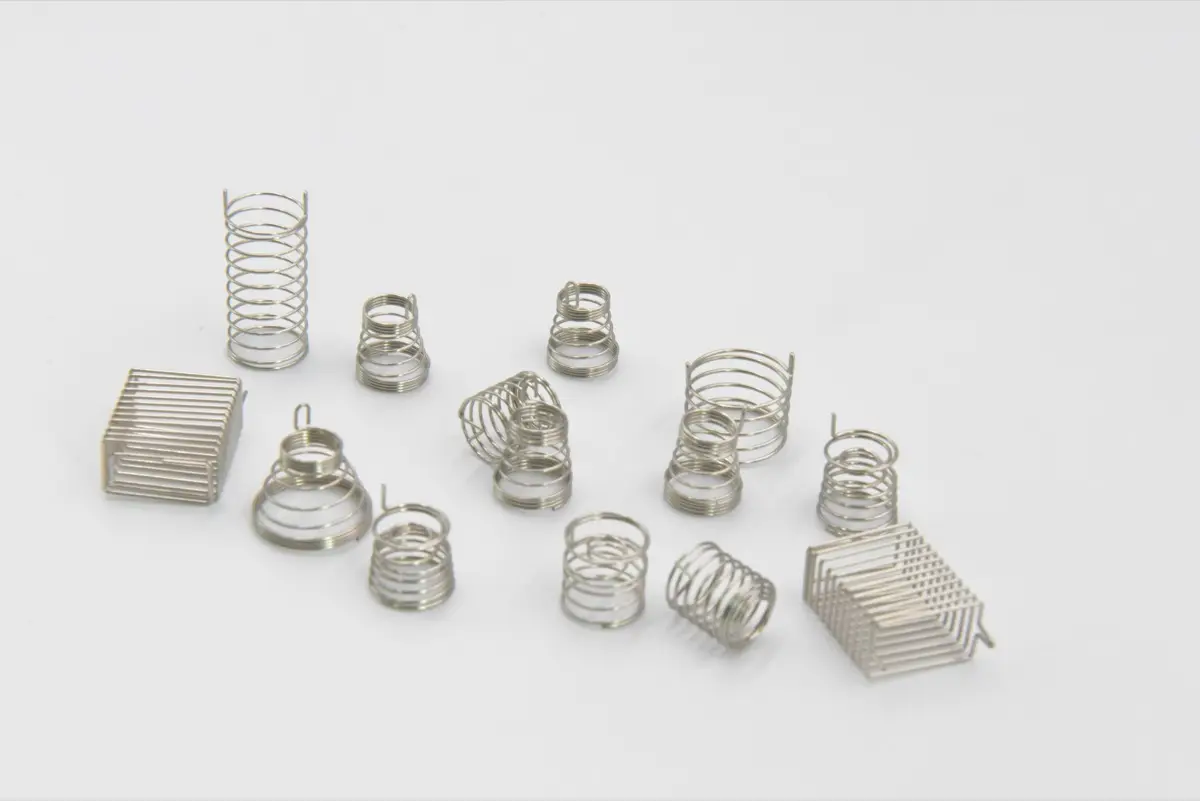
Every maintenance professional eventually faces this meeting: the machine is down, and someone asks why money is “sitting on shelves in the form of springs.” A spring is a compact, inexpensive part of an expensive assembly — which is exactly why its stock is easy to write off as unnecessary frozen capital. Justifying it takes the language of economics, not engineering: what an hour of stopped production actually costs, and which is cheaper — holding stock or waiting for a batch. This article is about the internal case: how to break the cost of downtime into its components, how “buy it when it breaks” differs from planned purchasing, and how to present the idea so management approves it.
One note on structure: in a separate article we already covered how to size a spring stock with the formula “consumption × lead time + safety stock” — that one was about how much to hold. Here we barely touch the “how much” question: the assumption is that the sizing method is known, and the task is to prove inside your company that this stock is needed at all.
We have been manufacturing springs since 1979 and ship serial and spare batches to more than 40 countries, including the mining sector — so many of the examples below come from heavy-equipment maintenance practice.
1. What an hour of downtime costs: the anatomy of a stoppage
When people say “downtime costs money,” they usually mean only the lost output. In practice, stopping one machine hits the company on at least five fronts, and most of them never appear in the reports:
| Downtime component | What it looks like | Why it is underestimated |
|---|---|---|
| Lost output | The machine misses its planned volume: the shift’s tonnage is not produced | Counted in revenue, not in margin; for vibrating machines, one stoppage drags the whole downstream process with it |
| Paid staff with no output | The crew is on site, the machine is idle | Wages are already budgeted, so the loss “doesn’t feel” like an expense |
| Collateral damage | An emergency stop under load damages adjacent assemblies; restarting is its own procedure | Booked under “repairs,” not under “consequences of downtime” |
| Missed commitments | A broken schedule, penalty clauses, lost customer confidence | The most expensive component and the hardest to quantify |
| Rush logistics and restart | Airfreight for the part, overtime, bringing the line back to operating mode | Classified as “one-off costs,” yet the story repeats at every stoppage |
Two practical conclusions. First: a stoppage almost always costs an order of magnitude more than the part that caused it — that is the key asymmetry on which the whole stock justification rests. Second: nobody inside a plant will compute the exact figure, and the argument doesn’t need it — an order of magnitude plus an honest admission that downtime is measured in shifts, not minutes, is enough.
2. Why “buy it when it breaks” is more expensive: supply time vs repair time
The “buy per replacement” strategy hides a trap: it assumes the part’s lead time is comparable to the time needed to replace it. For springs this is off by orders of magnitude:
| Event | Typical duration |
|---|---|
| Replacing a spring in the assembly (part in stock) | Hours, at most one shift |
| Manufacturing a serial batch at the factory | Several weeks |
| Delivering the batch from abroad | Several more weeks; in peak seasons the timelines stretch — we published orientational transit times from China in a separate breakdown |
Add the last two lines together and you get the core inequality: a repair that takes hours by itself stretches into weeks — sometimes months — when the part is not in stock. And the problem is not solved by a “rush order”: a custom spring made to the customer’s drawing cannot be picked off a shelf; it has to be manufactured, and that production lead time is not shortened by a phone call.
There is also a structural backdrop that works in favour of stock in 2026. According to industry surveys published this year, about two thirds of industrial companies have re-oriented their spare-parts purchasing toward Chinese suppliers, and roughly half have no domestic substitute for critical items. For spring items this means the alternative of “urgently buying on the local market” simply does not exist for many assemblies: either the order is placed in advance, or the assembly stands down for the entire manufacturing and delivery lead time. A general industry push toward traceability — digital marking is already being introduced for certain categories of spare parts — works the same way: the replacement log we described in the stock-sizing article turns from a mechanic’s personal initiative into standard record-keeping.
3. A simple model for the internal case
Management does not need an academic calculation — it needs two values made comparable: what it costs to own the stock, and what it costs to risk being without the part. A four-step model:
- Pick 3–5 critical items. Not “springs in general” but specific items on specific machines: the springs of the main screening line, feeder springs — assemblies whose stoppage stops the process.
- Estimate the replacement frequency. From the replacement log — the actual replacement interval per item. If no statistics exist, that is itself an argument: the proposal includes “start keeping records,” with the first purchase sized for recalculation.
- Express the consequence of a stop in units of output. Not in money: “one shift of screen downtime is N tonnes we do not crush.” Management will convert it into money itself — and trusts that figure more, because it is its own number.
- Compare the two sides of the balance.
| Side | What it consists of | Scale |
|---|---|---|
| Owning the stock | Working capital frozen in a batch, a few square metres of shelving, write-off risk if the assembly is modernised | Bounded and known in advance: the contract sum is fixed before the purchase |
| The risk without stock | Lost output over the whole manufacturing and delivery lead time + rush logistics + collateral damage | Unbounded and unknown in advance: it depends on when exactly the part fails |
The key sentence for the meeting: a spring stock is not an expense but insurance for the production programme. The premium is the price of the batch, known to the last cent; the payout is a stopped line whose duration nobody knows. What matters in the case is not the absolute size of the premium but its ratio to the possible payout: once the count runs in shifts of lost output, that ratio almost always favours holding stock.
An honest caveat that strengthens the case rather than weakening it: the model does not require proving that every item needs stock. For auxiliary equipment with easy replacement and long replacement intervals, it genuinely may not. The proposal sounds more convincing when it says explicitly: stock is introduced for critical items; for the rest — planned per-replacement purchasing.
4. Four typical mistakes when building a spare stock
Even an approved stock budget is often spent inefficiently. Four mistakes we most often see from the supplier’s side:
- Stock for machines instead of stock for wear parts. Companies buy a second gearbox “just in case” while the springs — parts that wear out by the nature of cyclic loading — are left with no reserve. The proportion should be the opposite: machinery gets repaired, springs get replaced.
- Choosing a supplier on unit price alone. The cheapest batch with unconfirmed material and load characteristics is a future unplanned stoppage. The full cost of an item is made up of its service life and the cost of the stoppage its failure causes; verifying a batch with load testing across a 50 N to 60 t range and receiving a test protocol costs incomparably less than a single stoppage caused by that “saving.”
- No replacement log. Without it, decisions are made from memory and from the emotions of the last breakdown: sometimes stock doubles, sometimes the storeroom turns out empty. The replacement log is the cheapest stock-management tool in existence.
- Ignoring critical custom items. Standard fasteners and consumables can be bought quickly; springs made to drawings cannot. It is exactly these items where the absence of a reserve hurts most, and exactly these that should enter the stock first, ahead of the planned replacement.
A note on ordering from abroad: the minimum order quantity and the price depend on the item’s dimensions, the tooling and the inspection scope, and both are best discussed while the stock decision is still being made — we covered that logic in our article on minimum order quantities. A supplier agreed in advance, with a proven routing, is part of the stock system, not just a line in a contract.
5. Checklist: how to present the idea to management
An internal proposal that gets approved usually contains five elements:
- The list of critical items and assemblies — 3–5 items, each tied to a machine and to the consequence of its stoppage for the process.
- The replacement interval or consumption — from the replacement log; if no statistics exist, a plan to start collecting them with the first batch.
- Downtime consequences in units of output — how much the company does not produce per shift and per week of assembly stoppage; no invented figures, only measurable units.
- The cost of owning the stock — batch size, floor space, working capital; plus the terms of repeat orders on the proven routing.
- Plan B if the stock is not approved — a supplier agreed in advance with a confirmed manufacturing and delivery lead time, a priority slot in their production schedule, and a document package for the item. Even this weaker option reduces risk compared with “we’ll start looking when it breaks.”
Our role here: from a drawing, a photo with dimensions, or an old sample we confirm manufacturability, return a quotation within 24 hours, and produce samples within 48 hours of drawing approval — so a critical item enters your stock from a verified part rather than from a hope. Serial batches ship with marking and a product passport, the load characteristic is verified on a test bench covering 50 N to 60 t, and repeat orders run on the same routing. The factory operates under an IATF 16949:2016 quality system (includes ISO 9001:2015 requirements, Intertek certificate No. 0495241), produces around 900 tonnes of output per month, makes springs from wire from 0.1 to 80 mm in diameter — including hot coiling up to 80 mm with developed lengths up to 18 m for mining machinery — and ships to more than 40 countries.
A spring stock is insurance for the production programme: the premium is known in advance, and the payout on a claim is a stopped process. A small part protects a shift that costs many times more.
Send us your list of critical items — we will help you build a stock specification with prices, lead times and the inspection scope. Fast channel — the Telegram bot @xulong_ru_inquiry_bot, or submit your request via the form on the Contacts page.
Need a calculation for a specific part? Send a drawing or describe the duty conditions of the assembly — a factory engineer will prepare an offer. Contact: info@xulong-pruzhiny.com.