
Springs for vibration isolation of industrial equipment: a guide
How to select springs for equipment vibration isolation: applicability limits, five input data points, six questions for the factory, and typical ordering mistakes.
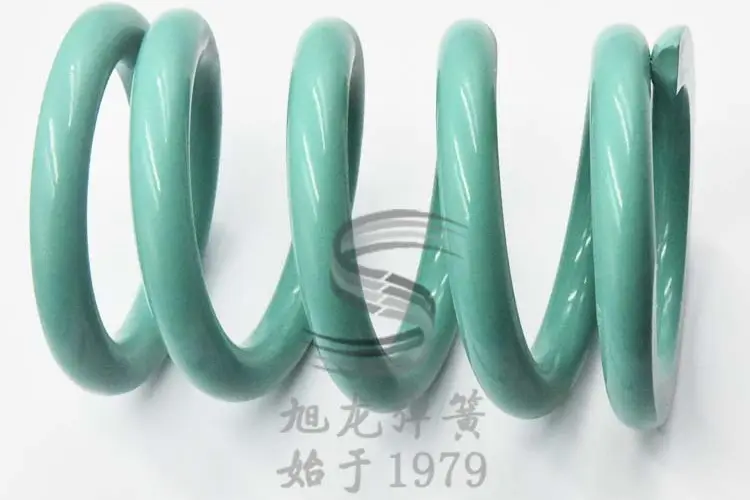
A spring vibration mount is a unit in which the entire isolation job rests on a single part: the elastic element. The housing, the base plate, the damping insert and the fasteners all matter, but it is the spring that determines how the mount behaves under design load a year later — and five years later. So when a machine tool, chiller, pump skid or press starts transmitting vibration into the foundation, the question “who made the spring, and with what kind of testing” usually comes before the question about the housing.
This article is for engineers and buyers who select springs for vibration isolation of industrial equipment and prepare a manufacturing order. We cover where the line runs between spring and rubber mounts, which five data points the factory needs, how mount configurations differ, which six questions to ask the manufacturer before ordering, and which mistakes most often surface after installation.
Let us set the boundaries of responsibility first. Designing and tuning the isolation system itself — the layout of the mounts, the natural frequencies, the coordination with the foundation — is the job of the equipment designer or the engineering firm. The spring manufacturer has a different task: to produce the elastic element exactly to the agreed parameters and to confirm them with measurements. An overview of spring isolator applications is available on our industrial vibration isolators page; here we focus on the practical side of selection and ordering.
Spring mount or rubber mount: where the line runs
The first question splits all isolation tasks into two camps: what to use as the elastic element — a spring or a rubber mount. There is no universal “better”; the choice is driven by two quantities — the load per mount and the frequency of the disturbance.
Spring mounts win where the mass is large and the required static deflection is significant: the greater the static deflection of the elastic element, the lower the natural frequency of the mount and the wider the range of disturbances it isolates. A steel spring carries load for years without creep, and it survives temperature, oil and contaminated shop environments where rubber ages and loses its properties. A rubber mount, in turn, is compact, provides damping “in the material” and works well with light equipment excited at higher frequencies.
| Criterion | Spring mount | Rubber mount |
|---|---|---|
| Load per unit | from tens of newtons to tens of tonnes per element | limited; heavy masses require multi-block arrangements |
| Static deflection | large — low natural frequency | small — stiffer mount |
| Excitation frequency | effective at low frequencies | more effective at higher frequencies |
| Damping | added as a separate damper | built into the material |
| Environment | metal resists oil, coolant, dust, temperature swings | rubber is sensitive to the environment and ages |
| Creep under load | practically absent | develops over time |
In practice the two solutions often coexist: the spring carries the static load and sets the low natural frequency, while a damping element adds attenuation during resonant start-up and coast-down. For the buyer this means one thing: a spring should not be ordered “in general” but for specific load, deflection and environmental conditions — with those parameters confirmed by measurement.
What drives the selection: five input data points
Selecting a spring for a vibration mount is not picking from a catalogue; it is manufacturing to a calculation. The more complete the input data, the shorter the path from enquiry to a conforming batch. The five items below are the minimum — without them the factory has to guess on behalf of the designer, which is the worst possible scenario.
| Input data | What it gives the factory | What happens without it |
|---|---|---|
| Load per mount | working force range, wire/bar diameter, number of coils | the spring is sized “by feel” from equipment weight, and the margin is a matter of luck |
| Design stiffness or static deflection | target stiffness used as the acceptance criterion | nothing to measure against: “stiff/soft” is not a criterion and acceptance disputes are inevitable |
| Nature of excitation (frequency, shocks, peaks) | decision on shot peening, load margin, stabilisation | a dynamic application gets a static part — the coil fatigues early |
| Environment (oil, moisture, outdoors, chips) | coating and material selection | a “standard” coating fails in the environment — corrosion changes how the mount works |
| Envelope and connections (seats, height) | end geometry, shape of the bearing coils, height tolerances | the spring “almost fits” and is reworked on site |
A note on stiffness, because the whole acceptance procedure revolves around it. The vibro-acoustic calculation of the equipment is made for a specific mount stiffness; if the delivered springs deviate in force, the calculation loses its meaning before installation. So the order should fix stiffness as a number (force at a defined height or load), and the factory should confirm it with a test protocol — for the controlled batch, not a sample from it. How such parameters are formulated in technical documentation is covered in our article on spring drawing parameters.
Single mount, group and damper configurations
The second practical question is how the springs work inside the unit. There are only a few layouts, and each changes what you should fix in the order.
A single mount — one spring carries one point of the machine. What matters here is that the actual stiffness matches the calculation, and the quality of the bearing coils: a skewed seat shifts the load to the edge of the coil, and fatigue life drops disproportionately.
A group of mounts — the equipment stands on four, six or more springs. The key risk is uneven mass distribution: if the group is fitted without accounting for the real centre of gravity, some units are underloaded, some overloaded, and the “average stiffness of the group” guarantees nothing. For series applications (chillers, ventilation units, centrifuges) batch-to-batch repeatability matters too: volume production of mounts is impossible if every set of springs has to be individually matched.
Housed and damper configurations — a spring inside a housing with a damping element, or paired with one. The spring remains the elastic element, but tighter requirements apply to end shape and seating in the housing: free length, diameter and alignment of the bearing surfaces must be held more tightly than in an open mount. The same applies to hanger isolators for pipework and ventilation: a small spring of fine wire works in a confined housing, and geometry there matters no less than force.
| Layout | Key requirement for the spring | What to fix in the order |
|---|---|---|
| Single mount | exact match of stiffness to the calculation | force at working height, tolerance, protocol |
| Group of mounts | repeatability within the set and across batches | force spread within the set, marking, batch-level control |
| Housed / damper mount | seating geometry: length, alignment, ends | free height, parallelism of ends, tolerances |
| Hanger isolator | compact size at a given force | wire diameter, free length, preload force |
In all four cases the spring is made by the factory to a drawing or agreed parameters, while the housing and damper come from the mount maker — or from the same drawings. The boundary is the same as at the start of this article: the unit layout belongs to the designer, the elastic element parameters to the factory.
Six questions to ask the factory before ordering
Answers to the six questions below separate a manufacturer that knows how to make elastic elements for vibration mounts from a shop that “also makes springs”. The questions demand specifics — numbers, equipment, documents — so vague replies are diagnostic in themselves.
| # | Question | What the answer shows |
|---|---|---|
| 1 | What wire/bar diameter range do you coil, and where does hot coiling start? | the real process range; large mounts for presses and heavy units need hot coiling of bar — up to 80 mm with a developed length of up to 18 m |
| 2 | How do you test stiffness and force: on what equipment, in what range? | the testing base: load testing on machines from 50 N to 60 t covers both small hanger springs and large mount elements |
| 3 | Do you use shot peening, and for which applications? | understanding of fatigue strength; for dynamically loaded mounts (pumps, compressors, presses) peening marks a mature process |
| 4 | Which coatings do you offer for oily, wet and outdoor environments? | attitude to operating conditions: zinc plating, cataphoresis, Dacromet — chosen for the environment, not “standard” |
| 5 | How do you ensure force repeatability within a batch and from batch to batch? | process maturity for series mounts: force control across the batch, not spot checks |
| 6 | Which documents accompany the batch: material certificates, test protocols, passport? | traceability and acceptance against recorded criteria, not on trust |
Add one organisational question: who certifies the quality management system behind the batch. For industrial supply chains the reference point is a certified system under IATF 16949:2016 (which includes the requirements of ISO 9001:2015; our plant’s certificate is Intertek №0495241) — such an audit assumes process control and traceability, not just end-item inspection.
One practical point on spare parts. Vibration mounts work for years, and replacement of the elastic elements tends to arrive when the original order parameters are long forgotten. If the factory keeps archived protocols and tooling, a repeat batch against the old drawing takes days, not weeks; our separate article covers how to organise a spring spare-part stock.
Typical mistakes: resonance, uneven loading, unaccounted forces
Most isolation problems surface not at acceptance but after installation. The four mistakes below are the most common, and all four are cheaper to prevent at the ordering stage.
Resonance. If the natural frequency of the supported system lands close to the excitation frequency, the mount amplifies vibration instead of isolating it. The calculation belongs to the designer, but the factory has its role: the actual spring stiffness must match the design value, confirmed by a protocol rather than a signature on a delivery note. A gap between calculated and measured stiffness is the first cause of “sudden” resonance on machines that should run quietly by design.
Uneven load across a group. Equipment with an off-centre centre of gravity is placed on four identical springs — and ends up with four different working deflections. The better way is to order springs as a set that accounts for mass distribution: different stiffnesses or different free heights per position, with marking so installers do not mix them up. A factory that asks about the centre of gravity at quotation saves you that rework.
Unaccounted forces from pipework and connections. Mounts are sized for the machine weight, while reactions from nozzles, attached services and thermal expansion are forgotten: the spring works under a load it was never designed for. The fix is to include these forces in the specification up front; on the factory side this translates into a load margin and clarification of working heights.
Shock regimes at start-up and shutdown. Diesel generators, presses and transformers during short circuits produce peaks many times above the working load. Such units need a peened coil, stabilisation and travel limiters in the mount design. Ordering a spring “for static weight” here is pointless — it will pass acceptance and not survive the first month of starts.
The common denominator of all four mistakes is the same: the unit parameters and the spring parameters never met in a single document. Asking the designer to write down load, deflection and environment in the specification costs minutes; reworking mounts on installed equipment costs weeks.
What ordering from a manufacturer looks like
Once the input data is assembled, the chain is short. On an enquiry with the unit parameters the factory prepares the calculation and quotation within 24 hours; against an approved drawing, samples are made in 48 hours for verification on your side; after sample approval the batch runs with load acceptance and a full set of protocols. Series applications go with batch-level force control and traceability from the material heat to the packing list.
This is how it works at our plant. We have been manufacturing since 1979; the coiling range runs from 0.1 to 80 mm — from small hanger-isolator springs to hot-coiled bar with a developed length of up to 18 metres for press and heavy-equipment mounts; monthly capacity is 900 tonnes. Load testing is performed on machines from 50 N to 60 tonnes, so both a ventilation hanger spring and a crusher mount element can be accepted against force; the quality management system is certified to IATF 16949:2016 (including the requirements of ISO 9001:2015, Intertek certificate №0495241).
If you are selecting springs for vibration mounts and want to verify parameters with the manufacturer, send the load, design deflection and environment to our Telegram bot @xulong_ru_inquiry_bot or via the contact form: we will return a calculation and quotation within 24 hours, and against an approved drawing supply samples in 48 hours with a test protocol. For large mount elements for presses and heavy equipment, see also our article on hot coiling springs up to 80 mm and the large-diameter springs page.
Need a calculation for a specific part? Send a drawing or describe the duty conditions of the assembly — a factory engineer will prepare an offer. Contact: info@xulong-pruzhiny.com.